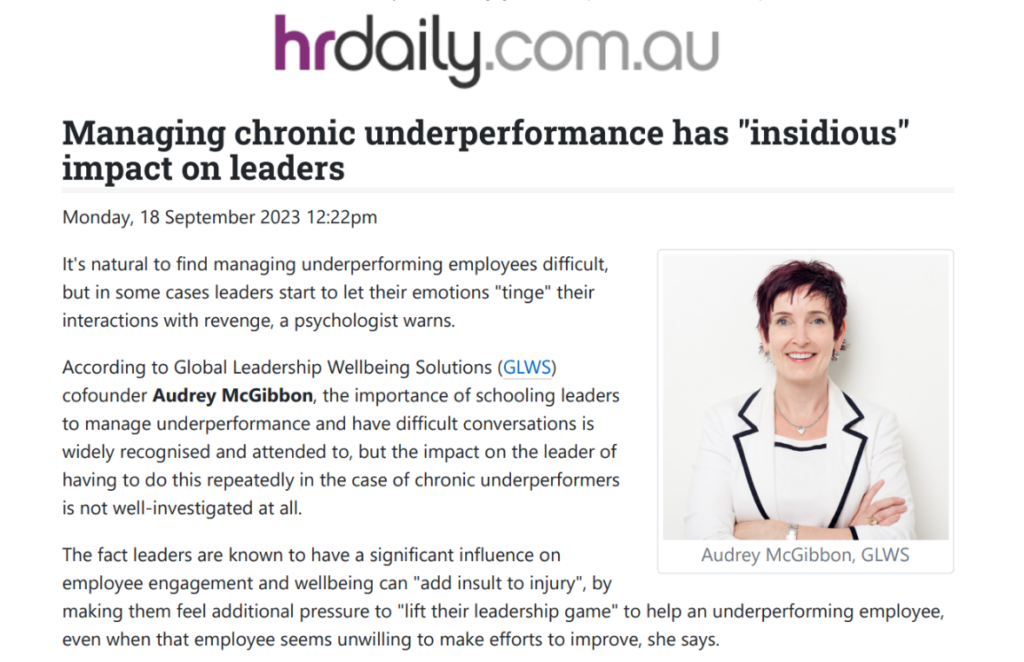
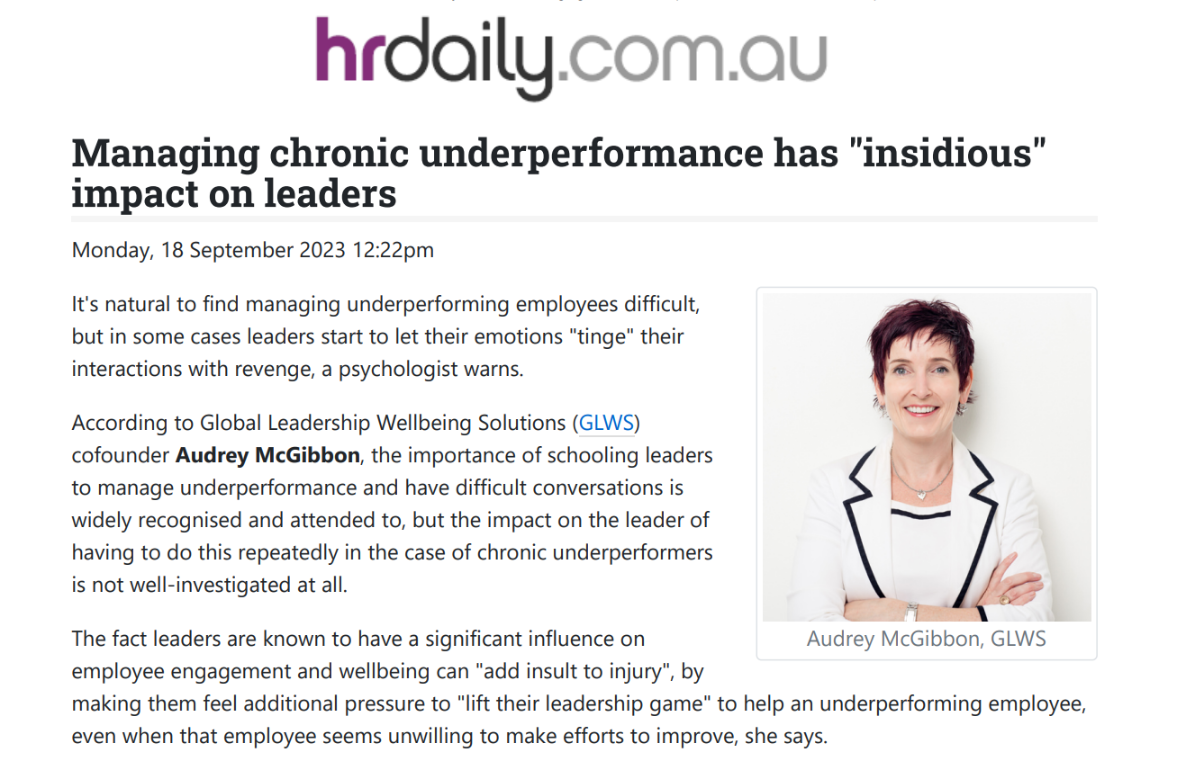
In this HR Daily feature, Audrey McGibbon turns a familiar management challenge on its head. Organisations invest heavily in training leaders to manage underperformance and hold difficult conversations — but the toll that repeatedly managing a chronic underperformer takes on the leader themselves is, as Audrey notes, barely investigated at all.
Over time, a worn-down leader can slip into what psychologists call “abusive leadership” — small, instinctive retaliations that don’t match their own standards and quietly erode how they see themselves. It’s a characteristically GLWS observation: while a leader’s impact on a struggling employee is closely watched, the reverse impact goes completely unnoticed.
The good news, Audrey says, is that HR awareness and support can make a world of difference.
Key takeaways:
- The performance-management relationship runs both ways — a chronic underperformer’s impact on their leader’s wellbeing is real, but almost always overlooked.
- Repeatedly managing an underperformer is draining, time-consuming and frustrating, and can leave leaders feeling guilty and conflicted about how they’ve behaved.
- Worn down over time, even a normally “lovely” leader can drift into low-grade “abusive leadership” — small retaliations that diminish their own self-image.
- HR intervention starts with awareness: naming the risk to the leader’s wellbeing, not just the performance issue itself.
- There’s a crucial difference between acknowledging emotion and being emotional — naming a feeling (“the impact this is having is taking its toll”) can make for a higher-quality conversation than forced neutrality.
- Timing is the “golden rule”: leaders should share emotion after recalibrating, never in the heat of an “amygdala hijack.”
- As the higher-status role model, a leader’s conduct shapes how others see them — so protecting their own wellbeing protects their leadership.