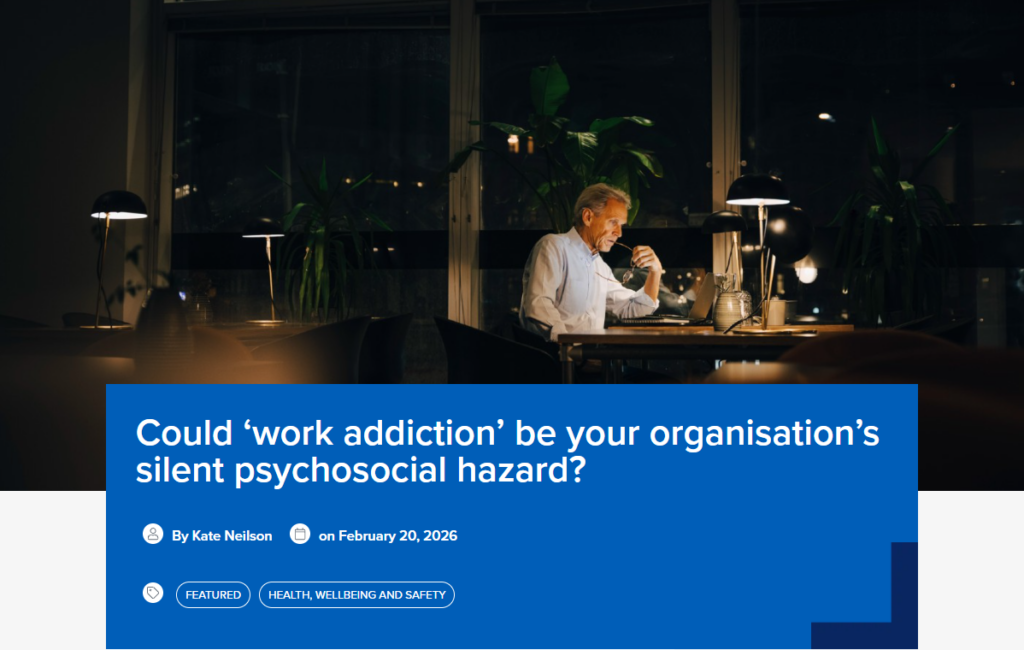
Published by the Australian HR Institute, this feature draws on Audrey McGibbon’s expertise to reframe work addiction as a genuine — and often invisible — psychosocial hazard.
Between 12 and 15% of the workforce, Audrey explains, struggles with an uncontrollable compulsion to overwork, rising to around 25% in high-pressure fields like law, finance and health.
Her central message cuts to the heart of the GLWS preventative philosophy: “We’re constantly talking about burnout, but burnout is the outcome of unmanaged chronic work-related stress… If we’re measuring burnout, it’s already too late.”
The piece also updates the picture for 2026 — with psychosocial duties now embedded in standard WHS compliance, employers are expected not just to acknowledge these risks, but to actively mitigate the systemic drivers of overwork.
Key takeaways:
- Work addiction affects an estimated 12–15% of the workforce — around 25% in high-pressure sectors — and is a genuine, often-hidden psychosocial hazard.
- Burnout is a lagging indicator: by the time it’s measurable, the damage is done. Work addiction is the underlying driver worth catching earlier.
- Counter-intuitively, a supportive, high-autonomy manager can heighten risk for driven people — “support” now has to include proactive monitoring of hours, not just goodwill.
- Glorifying busyness is a cultural red flag; what was once praised as “dedication” can now expose employers to vicarious liability under psychosocial duties.
- The evidence links chronic overwork to worse performance — the most effective leaders average around 52 hours a week, while those exceeding 70 are rated less effective.
Audrey offers a practical diagnostic: treat work addiction like any addiction, watching for six factors — salience, tolerance, mood change, conflict with other parts of life, withdrawal, and relapse.